Turban Chic: Paul Poiret

(Woman’s Turban, 1911, courtesy of LACMA)
I know I know, we’ve been talking turbans for over a year, and I am just now getting around to covering The Man himself, the O.G. of 20th century westernized turban appropriation (and arguably the most important and influential figure in the history of modern women’s fashion), the one and only Paul Poiret.
Every decade has a designer who, above all others, is able to divine and define the desires of women. In the 1910s, this was Paul Poiret, known in America as “The King of Fashion” and in Paris as “Le Magnifique”. That said, his influence extends far beyond a single decade. More than any other designer of the 20th century, Paul Poiret elevated fashion to the status of art.


(Fancy Dress Costume, 1911, courtesy of the Met’s Costume Institute)
Born into a working class Parisian family in the late 1870s, Poiret’s skilled hands and natural charisma gained him entry into some of the most exclusive ateliers of the Belle Époque, and he eventually rose to become one of the twentieth century’s great couturiers.

Poiret’s most immediately revolutionary contribution came when he shifted the emphasis away from the skills of tailoring to those of draping, moving the support point of the dress from the waist to the shoulders. Poiret’s reintroduction of the Directoire-style dress abandoned the lavishly ornamental S-curve corset of the Belle Époque for a straighter sheath-like garment, allowing greater bodily ease of movement. As such, Poiret played a pivotal role in sartorially liberating the female body, first from the petticoat in 1903 and then from the corset in 1906. Observe the sheer roominess:

(Opera Coat, 1911)

(Woman’s Afternoon Dress and Hat, 1923)
Now let’s talk Eastern influence….

(Chez Poiret by Georges Barbier, 1912)
Poiret was an Orientalist, drawing much influence from the art and design of the East, and favoring rich embellishment and embroideries. Further inspired by Leon Bakst’s extraordinary stage costumes for the Ballet Russes in 1910, he became enchanted with Russian, Near Eastern and Far Eastern costume ideas from which he borrowed, thereby introducing such exotic references to the haute couture. In 1910, he extensively studied the collections of Indian turbans at the Victoria & Albert museum. He soon made his own versions for his couture collection, and the turban quickly became an eveningwear staple and the ultimate luxe society accessory. From then on, it was (and remains) something of a signature for Poiret.

(Les Choses de Paul Poiret II by Georges Lepape, 1911)
In 1911 he became the first fashion designer to create and market his own perfume. In the same year, he also opened Martine, an interior design business. At first, Atelier Martine produced only textiles and wallpaper, but soon expanded to create carpets, lighting, hand-painted glassware and ceramics, and other items for interiors. Furniture and interior decorating services were introduced later on. In short, Poiret cultivated the first of fashion’s now-ubiquitous “lifestyle brands”, long before such a term was coined.

(Aladin by Rosine, 1919)
Poiret enjoyed continued success up until World War I, when he was summoned to military service, working as a tailor and helping streamline uniform manufacture. His postwar return was not met with the same success he had previously known. His love of the lavish and theatrical put him at odds with the ever-changing modernist aesthetic that overtook fashion after World War I, when people favored efficiency in every mode of life. And so began Poiret’s downfall. He sold the rights to his name in 1925 and the business was eventually closed by its new owners in 1929, with his remaining designs sold by weight as scrap. His wife Denise left him in 1928. Poiret spent the rest of his life doing odd jobs in relative obscurity and was by most accounts destitute by the time he died in German-occupied Paris in 1944.
For reasons not totally comprehensible to me, Poiret was relegated to the sidelines of fashion history for many years. His first major resurgence occurred in 2005 with “La Création en Liberté“, an auction held in Paris, consisting of more than 600 items belonging to Denise Poiret. Many pieces were purchased by major museums, including the Metropolitan Museum of Art, who then staged a sweeping retrospective exhibition, Poiret: King of Fashion, in 2007, thereby cementing his place in the canon and giving him the recognition that he has long deserved.
I’ll leave you with a few more classics.

(photographed by Edward Steichen, 1911)

(Dorothy Dickson, 1919)

(Peggy Guggenheim by Man Ray, 1923)
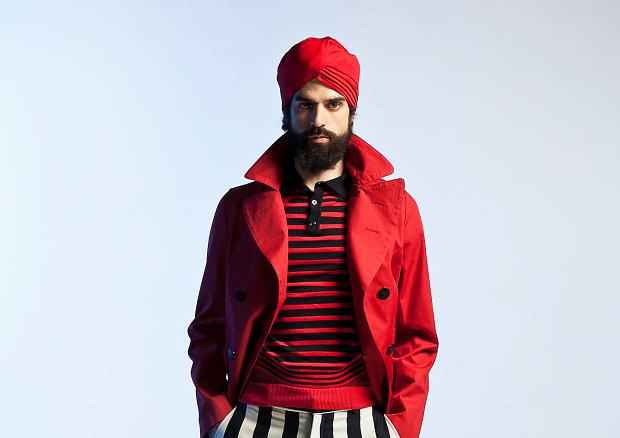
Turban Chic: Jean-Paul Gaultier Men’s S/S and Resort 2013
Do I detect a little Sikh influence in Jean-Paul Gaultier’s Spring/Summer 2013 Menswear collection? Turbans and beards galore!


All the looks in his Resort 2013 collection featured turbans too:


(all photos by Rainer Torrado / Courtesy of Jean Paul Gaultier)
A turban even suits the man himself, non?

(photo by Yannis Vlamos / GoRunway.com)
Turban Chic: Catherine Baba
Catherine Baba. Stylist. Bicyclist. Australian. Parisian. Turban enthusiast.
(photo by Hanneli Mustaparta)
(photo by Tommy Ton)
This one’s so dope it gets two perspectives:
Patron saint of heels on wheels.
(photo by Tommy Ton)
Turban Chic: Advanced Style Edition
First off, I must publicly declare my love for Ari Seth Cohen‘s blog Advanced Style. He’s got a great eye, and takes lovely photos. What’s most impressive to me though is his devotion to the depiction of beauty with a sense of depth, the kind that only comes from a life well-lived. So many aspects of modern American mass culture relentlessly encourage the ridiculously impossible pursuit of eternal youth, which is not only exhausting and offensive, but downright poisonous. Along with aging comes the accumulation of knowledge, the cultivation of satisfying relationships. and an experientially-derived stockpile of wisdom. Doesn’t that sound better than an inescapable inferiority complex and a mountain of cosmetic surgery bills? Ay!
Anyway, I digress. I also love turbans because they look fantastic on people of all ages. These elegant ladies are absolutely owning their looks.
I had to include 2 photos of Lynn Dell, because she’s so comprehensively amazing:
All photos are from a turban-centric post on Advanced Style from this past October. The full image gallery and original post can be viewed here. Enjoy!
Why the Turban?
(photo by Paolo Roversi for British Vogue)
I have always been drawn to headwear, especially when it is worn for a spiritual purpose. My best friend growing up was (and is) a devout Muslim, and I was always fascinated by her hijab and the connection it had to her identity. I also loved all of the beautiful fabrics, patterns and styles of scarves, and recognized the instant mystique that one has when they resolutely commit to a particular head garment.
As an adult, I am better able to relate to her experience, as I have become fond of wearing turbans. The reaction to it varies widely. I get compliments from fashionistas, quizzical looks on the subway, and my dear father genially informed me that I look like a terrorist. When I teach yoga, when I’m walking down the street, waiting for a train, or otherwise out and about, I am often asked, “Why the turban?”.
I am most connected to the lineage of Kundalini Yoga, which has ties to Sikhism (though they are separate disciplines). In traditional Sikhism, men cover their heads with turbans, and woman cover theirs with a draped scarf, or chunni. Many women wear turbans too.
(photo by Daniel Echeverri)
(photo by Gupt Kuri)
There are various reasons cited for this choice of headwear. It is a practical way to contain the hair, as most Sikhs never cut theirs. There can also be an element of historical deference, as all their gurus wore turbans. For most, the wearing of the turban has a multi-faceted significance that is rooted in one’s own particular spiritual (and human) experience. The turban is the “self-crowning of the individual”. It is a statement of inner commitment, a reminder to be conscious of our actions. It is an affirmation that we are all regal, and should both behave and treat ourselves accordingly.
Though I am not a Sikh, many of their reasons for wearing a turban make sense to me. I don’t wear it all the time, but when I do, I feel elevated and better able to be a disciplined, patient and compassionate human. I aspire to possess the ability to live in a perpetual state of consciousness without the aid of any external reminders, but this may be a lifelong pursuit. In the meantime, I’ll utilize the turban. It’s a bonus that they can also look quite chic.
So in short, for me it’s part internal reminder, part spiritual statement, and part fashion statement. That’s what I love about the freedom of sartorial expression. We don’t have to justify our appearance to anyone, but when we choose to discuss such choices, we can learn a lot about one another.